SkoveNet
SkoveNet is a decentralized Command & Control (C2) framework engineered to eliminate Single Points of Failure and ensure maximum operator anonymity.
Unlike client-server C2 models, SkoveNet implements a decoupled Agent-Controller architecture. This allows the operator to interface with the network through any active node, removing the dependency on a static command center and obfuscating the operator's physical location.
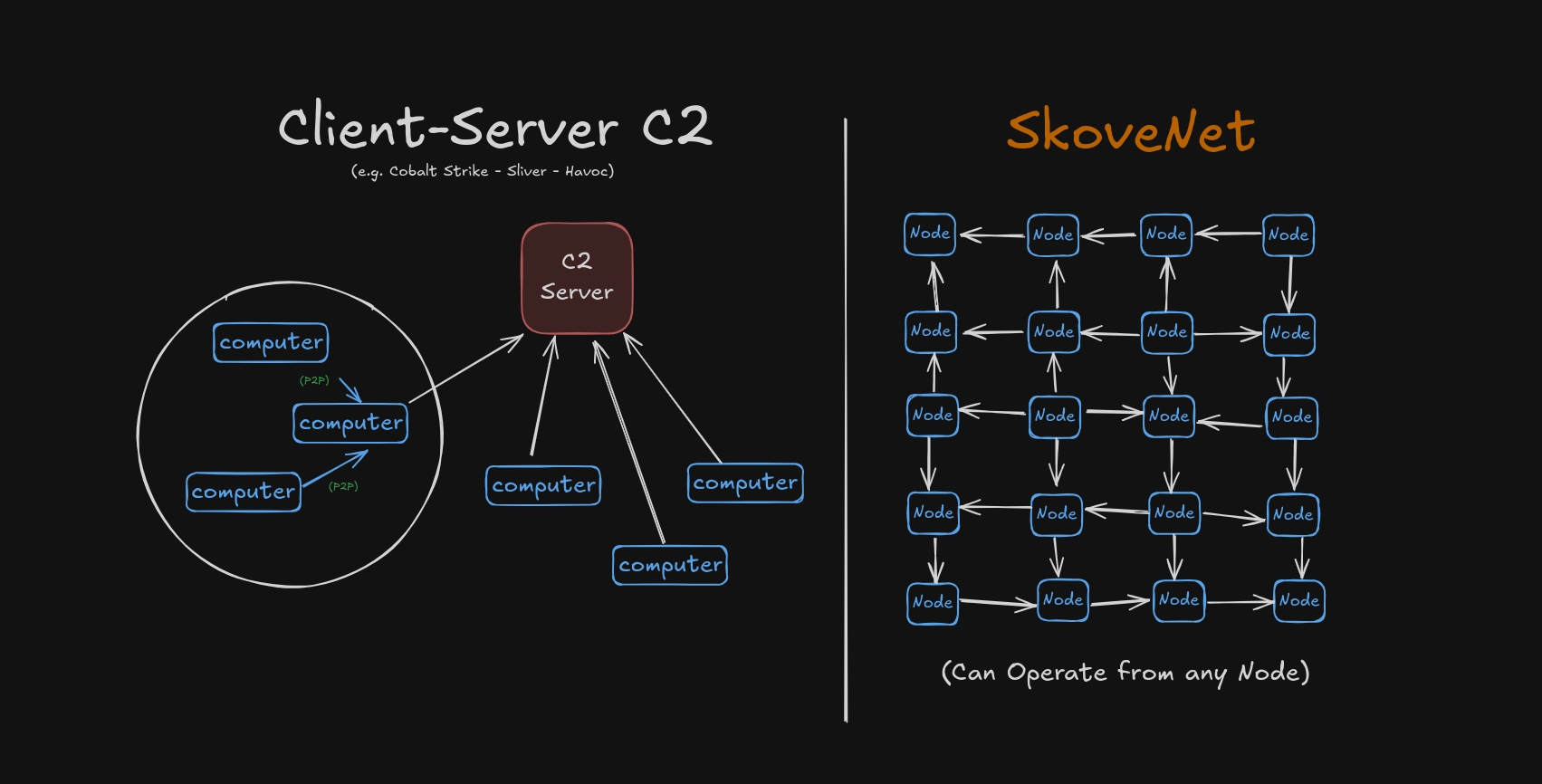
No single point of failure
Core Features
- Fully decentralized P2P mesh network
- Automatic self-healing topology
- Dynamic code generation
- Compile-time obfuscation
- Max 5 neighbors per agent → tiny traffic footprint
- Operator = whoever has the cryptographic secret key
- Commands signed with Ed25519 → no spoofing
- End-to-end encrypted (Noise protocol)
- GossipSub broadcast (fast & reliable)
- Single binary, zero dependencies – works on Windows, Linux, macOS, ARM
- NAT traversal & hole punching built-in
sgen— standalone agent generator (no Go toolchain required)
How It Works
Every machine in the network runs an agent. The agent is the network. it connects to peers, receives commands, and executes them. The controller is just a local CLI that talks to the agent running on your machine. It's how you, the operator, interact with the network. If you are not on the network yet, run agent to join, then run controller.
Tutorials
Learn how to deploy and operate SkoveNet:
- Getting Started: Environment setup and installation.
- Agent Generation: Creating implants with
sgen. - Mission Execution: Red team operations and mesh control.
Reference Documentation
Deep dives into the system internals:
- Architecture: How the decentralized mesh works.
- Security Model: Cryptography and authentication.
- Command Reference: Built-in agent capabilities.
- Developer Guide: Extending SkoveNet with new commands.
- Roadmap: Future features and planned enhancements.