From JavaScript Recon to PII Exposure
TL;DR
While reviewing client-side code and JavaScript assets, I first came across an order-status endpoint that returned sensitive tracking data and PII, but only when called with a high-entropy url_code (d7ebdc82-13eb-4cea-aea8-7ac96fe49d57).
After digging deeper in the source code and related request logic, I discovered the same endpoint also accepted a numeric, incremental tracking_number. Unlike url_code, this identifier was guessable, it returned the same full response payload. That made it possible to disclose other customers’ data without authentication, including exact location (lat/long), phone numbers, and personal details. I also identified a debug-related parameter that expanded the response and exposed additional customer fields. The issue has been reported and patched.
Recon: Finding an Additional API Base
I started with source code review and asset discovery:
- Enumerated JS files and endpoints using
urlfinderandgau. - Parsed JavaScript bundles to identify configuration objects and request wrappers that revealed an additional API base and route patterns.
I used a regex to extract candidate URLs/endpoints from JS, then filtered the results to “API-looking” paths
Discovery: An Endpoint Returning Sensitive Data

Among the extracted endpoints, one stood out: an order status route that returned rich tracking details. The response contained fields that looked like PII and operational delivery metadata (for example: location coordinates and delivery-related identifiers).
At first, the primary parameter to access the order appeared long/high-entropy, which made direct guessing impractical. I attempted light parameter analysis and fuzzing focused on obvious variations, but did not find additional behavior that way.
The Break: A Debug Parameter in Source
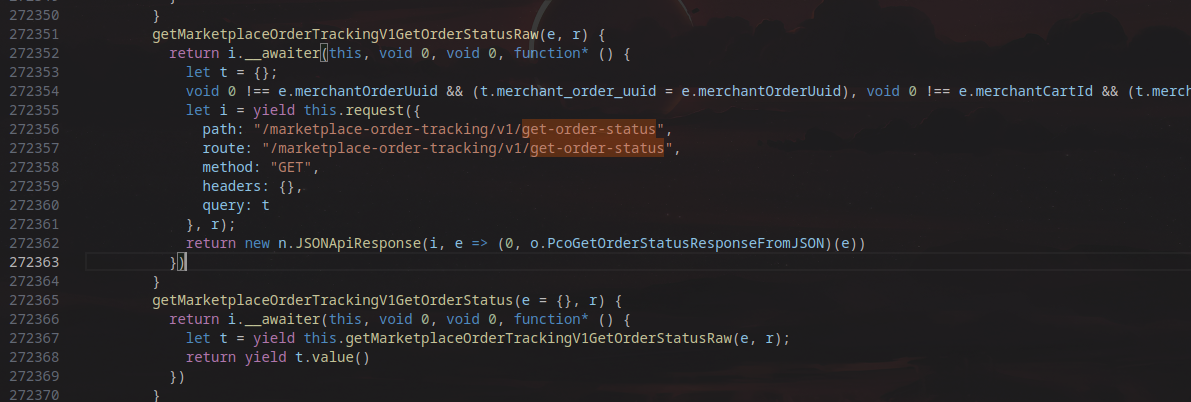
Returning to the source, I searched specifically for:
- The endpoint name/path
- References to “debug”, “verbose”, “trace”, “test”, “dev”, “include*”, “expand”, etc.
- Conditional logic around response shaping
That led me to a debug-related parameter tracking_number that changed the server response and caused it to return significantly more sensitive customer information.
The most important part is that tracking_number was numeric and incremental (brute-forceable), not a high-entropy value. That meant anyone could iterate values (1111, 1112, 1113, …) and each request would return order data for a different customer without authentication.
samples:
https://www.doordash.com/unified-gateway/drive/v1/get-order-status?tracking_number=1118

https://www.doordash.com/unified-gateway/drive/v1/get-order-status?tracking_number=1119

https://www.doordash.com/unified-gateway/drive/v1/get-order-status?tracking_number=1120
Root Cause (What went wrong)
The core design issue was that the service accepted multiple selectors for the same resource:
- One selector was intended to be unguessable/high-entropy.
- Another selector (or mode) effectively weakened access control and returned the same sensitive payload without requiring authorization.
In short: the API did not enforce object-level authorization before returning sensitive order/customer/dasher data, and a debug pathway amplified the exposure.
Impact
The exposed data included highly sensitive PII and delivery metadata, such as:
- Customer identity and address data
- Precise GPS coordinates (latitude/longitude)
- Courier/dasher identifiers and phone number
- Order identifiers and timestamps that could be correlated
Lessons Learned
- JS bundles frequently reveal “hidden” gateway routes and optional parameters.
- Any endpoint returning PII must be reviewed for BOLA/IDOR risk, especially if it accepts multiple identifiers.
- Debug flags are common footguns. If you see them in client code, treat them as high-signal review targets.